
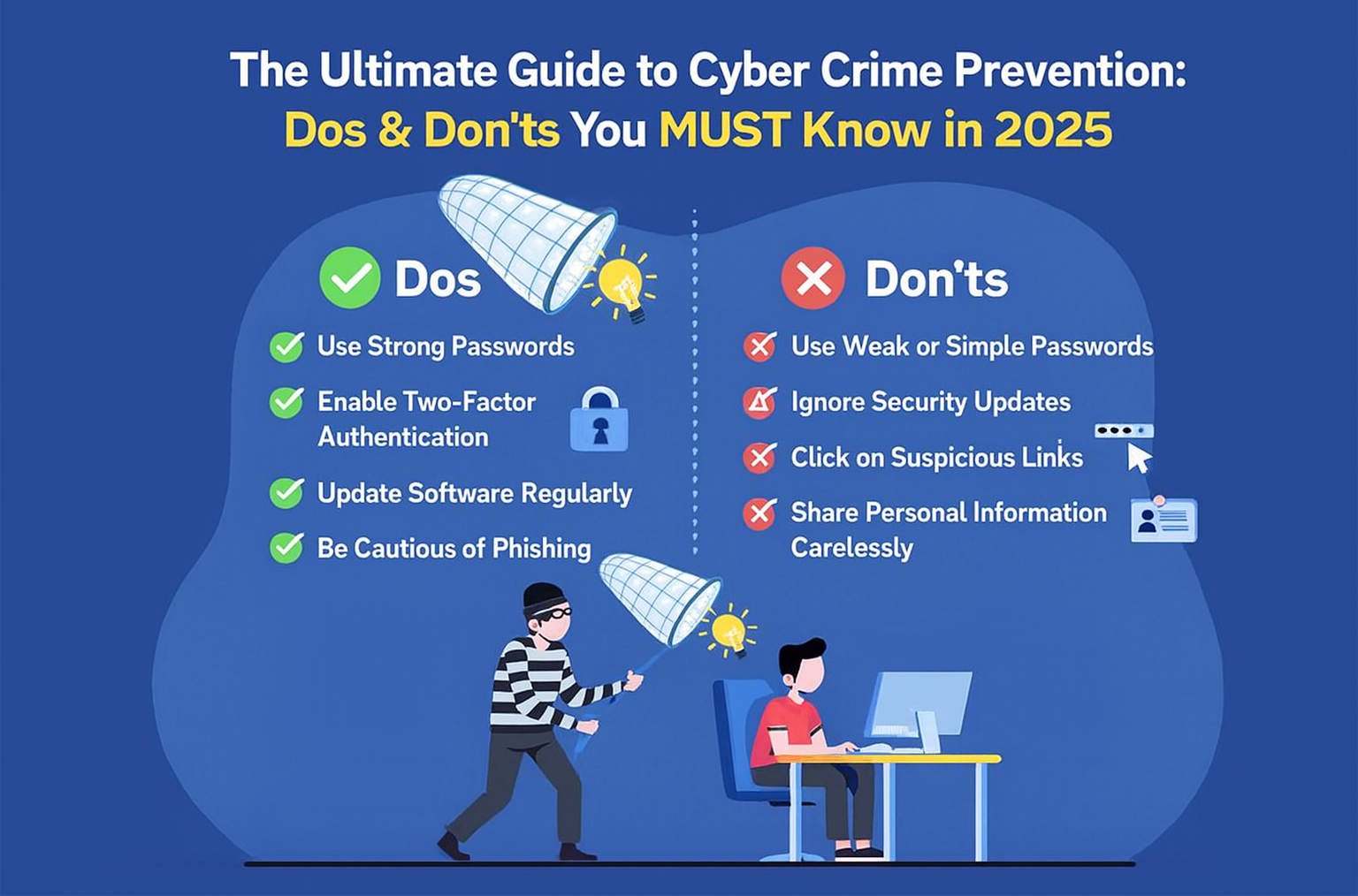
The Ultimate Guide to Cyber Crime Prevention: Dos & Don’ts You MUST Know in 2025
The Ultimate Guide to
Cybercrime Prevention
Dos & Don’ts You Must Know
Cybercriminals are evolving faster than ever in 2025. From deepfakes to SIM swapping, this complete awareness guide — compiled by Avinya Infotech — gives you everything you need to stay protected online.
In a world where nearly every transaction, conversation, and business operation happens online, cybercrime prevention is no longer optional — it’s a survival skill. India alone saw millions of cybercrime complaints in 2024, and the numbers are climbing sharply in 2025.
At Avinya Infotech, we work with businesses across India and internationally to build secure websites, eCommerce platforms, CRM solutions, and cloud applications. As a certified Zoho and Microsoft Partner, digital security is embedded in everything we deliver. This guide arms you with the knowledge to identify, avoid, and report the most dangerous cyber threats active today.
⚠️ 16 Cyber Threats — And How to Defeat Each One
Here are the most active cybercrime types in 2025, with clear dos, don’ts, and Avinya Infotech’s role in keeping your business protected:
KYC & Banking Scams
Fraudsters impersonate bank officials requesting urgent KYC updates to steal your credentials and account access.
- Contact your bank directly using official numbers only
- Verify the caller’s identity before sharing anything
- Never share your OTP, PIN, or password with anyone
- Don’t click links sent via SMS claiming to be your bank
Fake Job Offer Scams
Scammers post fraudulent job listings with unrealistic salaries to collect fees and personal data from unsuspecting job seekers.
- Use verified, official job portals only
- Always cross-check employer credentials independently
- Never pay any fee to secure or confirm a job offer
- Don’t share Aadhaar or bank details before confirming legitimacy
Online Shopping Fraud
Cloned websites and fake sellers lure buyers into advance payments for products that never arrive.
- Shop only on verified, well-reviewed platforms
- Prefer cash-on-delivery when buying from new sellers
- Never scan a QR code to “receive” money — it only sends
- Avoid deals that seem too good to be true
Digital Arrest Scam
Criminals impersonating police or government officials make video calls threatening “digital arrest” unless an immediate payment is made.
- Stay calm — digital arrest does not legally exist in India
- Disconnect immediately and report to cybercrime authorities
- Never pay money based on threats made over video calls
- Don’t share personal documents with unknown callers
Investment & Ponzi Schemes
High-return, low-risk investment schemes designed to trap victims with promises of guaranteed profits that vanish overnight.
- Invest only through SEBI-registered entities and platforms
- Research every platform thoroughly before committing funds
- Never trust “guaranteed returns” — no investment is risk-free
- Don’t join investment groups on WhatsApp or Telegram
Online Gaming Risks
Malware-laced apps, in-game social scams, and data-theft tools specifically target the online gaming community.
- Download games and apps only from official stores
- Review app permissions carefully before installing
- Never share account credentials with online teammates
- Don’t click external links shared in game chats
Lottery & Prize Scams
“Congratulations! You’ve won” — followed by a request to pay processing or tax fees before the prize can be released.
- Ignore and delete all unsolicited prize notifications
- Report suspicious messages to cybercrime authorities
- No legitimate prize ever requires you to pay to receive it
- Don’t share bank details to “claim” any prize
Phishing & Vishing
Fake emails, SMS, and phone calls impersonating trusted brands or banks to harvest login credentials and financial data.
- Check URLs carefully — look for misspellings or odd domains
- Keep browsers, antivirus, and OS fully updated
- Never share OTP or passwords via phone or email
- Don’t click email links — type URLs directly into your browser
Search Engine Fraud
Fake customer support numbers are placed as paid ads in search results, leading victims to call criminals posing as support agents.
- Always visit the official website directly for contact details
- Bookmark official pages of services you use regularly
- Don’t call numbers found in search ads without verifying
- Never share account details during an unsolicited support call
Social Media Impersonation
Fake profiles clone real individuals or business brands to deceive followers into sending money or personal information.
- Verify identity offline before transferring any money
- Enable two-factor authentication on all social accounts
- Never send funds based solely on a social media request
- Don’t accept friend requests from suspicious duplicate accounts
Fake APK Apps & SIM Swapping
Unofficial apps silently steal credentials while SIM cloning transfers your mobile number to give attackers access to your OTPs.
- Download apps exclusively from Google Play or the App Store
- Contact your carrier immediately if your SIM stops working
- Never install APK files from unknown websites or messages
- Don’t ignore sudden loss of mobile network signal
Money Mule Scams
Victims are recruited — often unknowingly — to transfer illegal funds through their bank accounts, making them legally complicit.
- Refuse any offer to use your account for “business transfers”
- Report suspicious approaches to your bank immediately
- Transferring illegal funds is a criminal offence — even if unknowing
- Don’t share your account details with people you’ve only met online
Juice Jacking
Tampered USB charging stations at airports and public spaces silently install malware or steal data while your device charges.
- Use your own charger plugged into a standard power socket
- Carry a portable power bank for travel charging
- Never plug your device into a public USB charging port
- Don’t charge at kiosks offering “free charging” without explanation
Deepfake Cybercrime
AI-generated fake videos and audio clips are used to manipulate, extort, or impersonate trusted individuals for financial or reputational damage.
- Verify shocking or unusual content through a second trusted source
- Use verification tools to detect AI-generated media
- Never share sensational videos without confirming authenticity
- Don’t respond to demands based on fabricated video “evidence”
Remote Access Fraud
Scammers pose as tech support agents and convince users to install screen-sharing software, then steal banking credentials in real time.
- Only allow remote access to verified, trusted professionals
- End any session immediately if banking is mentioned
- Never grant remote access to anyone who contacted you first
- Don’t enter any passwords while your screen is being shared
Ransomware & Malware
Malicious software locks your files, systems or devices and demands a ransom payment — often with no guarantee of recovery even if paid.
- Maintain regular, tested backups stored offline or in the cloud
- Keep all software and operating systems fully updated
- Never pay the ransom — it funds criminals and rarely recovers data
- Don’t open attachments from unknown or suspicious email senders
🛡️ How Avinya Infotech Keeps Your Business Cyber Safe
At Avinya Infotech, online fraud protection is not an add-on — it’s built into the foundation of everything we create. Whether you run a growing SME or a multi-location enterprise, our security-first approach covers every layer of your digital presence:
🚨 Faced a Cybercrime? Report It Immediately
Fast reporting dramatically increases your chances of recovering lost funds and preventing others from falling victim. India’s national cybercrime portal is available 24/7 — don’t wait, act the moment you suspect fraud.
🇮🇳 Report Cybercrime — India’s Official Portal
Every minute counts after a cyberattack. Visit the official National Cybercrime Reporting Portal or call the helpline immediately.
Get Help from Avinya Infotech →✅ Your 2025 Cyber Safety Checklist
Before you close this guide, commit these six non-negotiable rules to memory. They will protect you from the majority of cybercrime prevention failures:
🔐 Secure Your Business with Avinya Infotech
From secure websites to fraud-proof eCommerce and Zoho implementations — we build digital systems that keep your business and your customers safe in 2025 and beyond.
Talk to Our Security Experts →